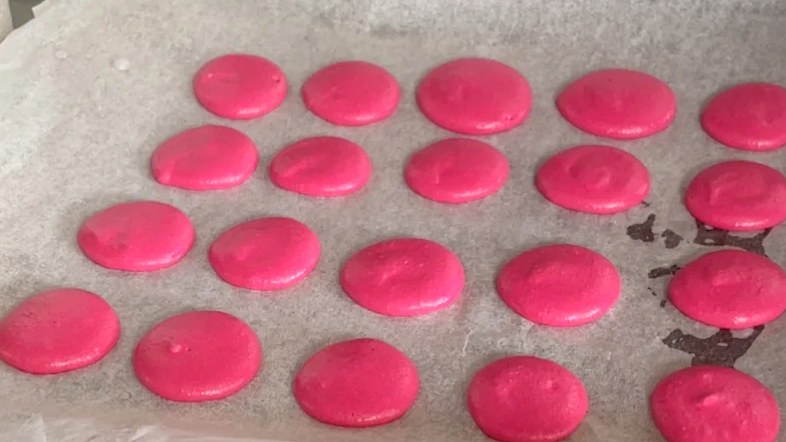
Intro
Macarons (the delicate French sandwich kind — not to be confused with amacaroon, the coconut one) have a reputation for breaking hearts. I won’t pretend they’re not fussy, but here’s the reassuring part: they fail inpredictable ways. Cracks, hollows, no feet — each has a cause you can learn to read and fix. This guide gathers my macaron masterclass, the bakes that show them off, and the technique behind every step, so the mystery turns into method. Bake them for their own sake, or borrow them as a bakery-window finish on cupcakes and cakes.
Start here — the masterclass
- Raspberry French macarons — the full step-by-step: the French meringue, the all-importantmacaronage, resting for feet, and a white-chocolate raspberry ganache. Naturally gluten-free.This is the one to learn first.
Macarons as a finish
Once you can make shells, they become the prettiest décor:
- Red velvet cupcakes with macaron tops — a mini macaron crowning each cupcake.
- Chocolate celebration cake — macarons and fresh berries over glossy ganache (bake it at home).
- Prefer us to make a celebration cake for you? Bespoke cakes are made to order for your occasion —email your idea for a quote.
The Craft — the make-or-break steps
Weigh, don’t count. Macarons are a ratio (equal almonds, icing sugar and — near enough — whites and caster sugar). A “medium egg” isn’t precise enough.(See:macaron ratio.)
Build a stable meringue. Whites to soft peaks, then sugar a spoon at a time to stiff and glossy. Gel colour only — liquid throws off the balance.(See:meringue (French).)
Master themacaronage. Fold until the batter falls in a thick ribbon that melts back in about ten seconds — “flowing lava.” Underfolded is lumpy; overfolded is flat. This one step decides more than any other.(See:macaronage,ribbon stage.)
Rest for a skin. Leave the piped shells until dry to a light touch — that skin is what forces the rise up intofeet rather than out.(See:macaron feet.)
Mature them. Filled and rested overnight in the fridge, the shells soften to the right chew. They’re genuinely better on day two.
Glossary — the terms, defined
Each links to its own page:
FAQ
Each also has its own page:
- Why did my macarons crack? — usually not enough resting, or trapped air.
- Why are my macarons hollow? — often overfolding or too hot an oven.
- Why don’t my macarons have feet? — undermixed batter or too much moisture/no skin.
- Why are my macarons lopsided? — uneven piping, oven hot spots, or a slanted tray.
- Do I really need to age the egg whites? — it helps; here’s why and by how much.
- How do I store macarons? — fridge in a tin; mature overnight, best within a few days.
Free-from
The shells arenaturally gluten-free — a lovely one for that theme page. They arenot nut-free (ground almonds are structural, with no reliable swap), so rather than promise a substitute, I’d point you to anut-free bake instead.